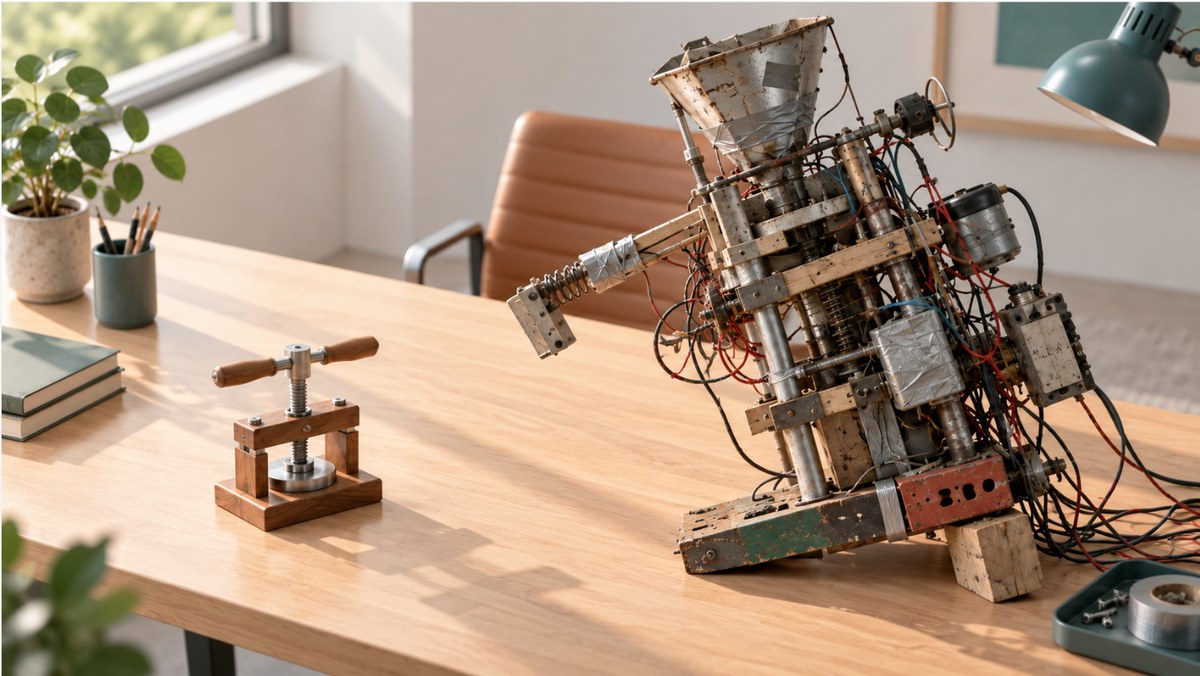
Someone on your team shows you a tool they built themselves. It pulls the figures for the monthly report from three different places, combines them and produces a finished spreadsheet. It used to take an hour. Now it takes ten seconds. They cannot code. They could explain what they wanted, and AI wrote the code.
Is this good news or a risk? Both. The line falls in a more specific place than most people would guess.
Yes, small tools are worth building
First, the good news. Right now, small tools that people make for themselves are the clearest benefit AI brings to everyday office work. A script that renames a hundred files. A macro that cleans up an export from a business system. A small calculator that helps a salesperson get a quote right first time.
Nobody would ever have commissioned these. The problem was too small to be worth paying anyone to solve. Now the solution takes an afternoon, and the saving is real.
Among professionals, the same shift shows up in the data. In Google's DORA research from September 2025, 90 per cent of nearly 5,000 software professionals used AI in their work, and more than 80 per cent felt it had improved their own productivity.
Now for the other side.
A demo is not software
When a program is made simply by describing it, its only test is usually this: it worked once, on the maker's computer, with the maker's own sample file. In software development, that route is called the happy path. Everything goes as it should.
Most of the real work happens off that path. What happens when the file is empty. When a date arrives in the wrong format. When there are 40,000 rows instead of 40. When two people save at the same time. When the connection drops halfway through a run. When someone types something into a field that was never meant to go there.
AI writes what it was asked to write. What nobody knew to ask for, it does not write. That missing part is exactly what decides whether the program survives a second user, next month or next year.
Almost half of AI-generated code is insecure
There is no need to guess. The security company Veracode has been running the same test suite against AI models for two years: 80 programming tasks in four languages, more than 150 models. The update published in March 2026 shows the same result as a year earlier. Only 55 per cent of the tasks produced secure code. The remaining 45 per cent contained a known vulnerability.
The average hides a more interesting finding. Protection against SQL injection and weak cryptography was usually implemented correctly, in 82 and 86 per cent of cases. Two other categories were not. Cross-site scripting, where an attacker gets their own code to run in the user's browser, passed the test in 15 per cent of cases. Secure handling of log data passed in 13 per cent. Neither figure has improved as the models have developed.
These figures describe the code that the models produce when the brief is written by a professional and the result is read by one. A developer spots a missing check by reading the code. Someone who cannot program will not spot it, cannot check for it and does not know to tell the AI to guard against it.
Code that looks as if it works even when it does not
A second measurement looks at what happens to code over time. GitClear has analysed 623 million code changes made between 2023 and 2026. The figures published in January 2026 tell a consistent story. The amount of copied code has grown by 81 per cent since 2023, and tidying up has all but stopped: in 2022, 21 per cent of changes were restructuring of existing code; in 2026, only 3.8 per cent.
One figure from the same data is worth reading twice. The number of error-suppressing constructs has grown by 47 per cent. This is code that swallows an error and carries on as if nothing had happened. The program does not crash; it keeps running as though it were working correctly.
This is the nastiest trait of a home-made tool. A broken program gets noticed straight away. A program that runs but calculates wrongly can keep going for months before someone checks the figures by hand.
The maker is the worst judge of how well it works
In July 2025, the research organisation METR ran an experiment whose result surprised even its authors. Sixteen experienced open-source developers worked through 246 real tasks in projects they already knew well. AI tools were allowed for some of the tasks and not for others.
When using AI, the developers were 19 per cent slower. Before the experiment, they had expected AI to speed up their work by 24 per cent. Afterwards, with the slowdown already behind them, they estimated that they had been 20 per cent faster.
The sample was small and the setting unusual: experienced developers working in large codebases they knew well. METR itself limits the result to this setting, and in February 2026 it announced that it would change the design of its next study. One thing, however, the experiment shows clearly. The feeling of speed and the measured speed were two different things, even for people who do this for a living.
That is why “it works for us” does not count as a quality assessment. It is the maker's experience of the maker's own work.
A tool does what it was asked to do, not what the process requires
The hardest part of software is rarely the programming or the technology. The hardest part is what actually happens in the business.
A home-made invoicing tool calculates invoices correctly. Then comes the first credit note. Then a customer who is also a supplier. Then the end of the financial year, an order cancelled halfway, reverse-charge VAT in construction, an advance payment against which nothing has been delivered yet.
Off-the-shelf software has run into all of these with hundreds of customers and fixed them. A home-made tool runs into them for the first time in your own accounts. AI does not know about exceptions nobody told it about, and the maker cannot tell it about the ones they have not come across yet.

Four questions that draw the line
The line between useful and dangerous does not depend on how skilled the maker is. It depends on what the program touches. Four questions are usually enough.
Does it read, or does it write? At worst, a tool that reads produces a wrong report, and a wrong report can simply be run again. A tool that writes can corrupt the source data. In July 2025, Replit's AI agent deleted entrepreneur Jason Lemkin's production database in the middle of an agreed code freeze, taking with it the records of more than 1,200 people and around 1,190 companies. The company's CEO called the incident unacceptable and said it should never have been possible. Replit then separated its development and production databases. That is the difference between reading and writing.
Does it involve personal data? The employer is the data controller, regardless of who wrote the code or whose computer it runs on. The processing belongs in the record of processing activities, and you must be able to explain how the data is protected. A customer register that an employee builds for their own use is still a register.
Does anyone else depend on it? One person's helper is one person's risk. Once the same tool runs the workflow of three people, it has become a system, even if nobody actually decided so or tested it on that basis.
Who fixes it in August? The maker is on holiday, has changed jobs or no longer remembers why some part is the way it is. If the answer is “nobody”, the program has already become technical debt. AI is certainly good at making sense of code later on, but it does not do so by itself: someone still has to guide and instruct it, and care about what it does.
When all four answers are harmless, go ahead. When even one of them points the other way, the tool needs an owner.
There are more of these than you think
In a survey of 1,250 office workers published by PagerDuty in June 2026, 66 per cent said they had used AI tools even though they believed it went against their employer's rules. As many as 88 per cent had entered work-related information into a public AI service. The survey covered large companies, where guidelines usually exist.
In a smaller company there is often no guideline at all, so there is nothing to break. Nor does anyone know what is being built. This is the new form of shadow IT: it used to mean software nobody had approved; now it means software nobody has even seen.
AI amplifies what a company already has
The same DORA report also points in the other direction. AI use correlates positively with delivery speed and negatively with delivery stability. The report's authors sum it up like this: AI does not fix a team; it amplifies what is already there. A good team does better work with it. A team in a mess makes a mess faster.
The same applies directly to a company that does not make software. If the business knows where its customer data is, who owns what and what is running in production, employees' own tools are pure gain. If it does not, the same tools create ten new places where company data sits, and nobody can list them.
Not everyone needs to know how to vibe code
One thing often goes unsaid in this discussion. Many people do not want to build their own tools or learn how to, and that is a perfectly valid position. Their expertise lies elsewhere, and that is what the company pays them for.
What works for them is getting the tool from someone who builds it properly, and these days quickly too, thanks to the same AI tools everyone else has. The difference is that this maker can read their own work, test it with the inputs nobody expects, write down how it works and fix it next year.
This also changes what you should expect from IT support. Support that understands both code and the current limits of AI can tell three cases apart: the tool that can go through as it is, the one worth building properly, and the one that has to be stopped. At Vukon Oy, this means in practice that the same people who look after the devices and access rights also write those small tools for the customer whenever that is the quickest route.
Back to that report
The tool that did an hour's work in ten seconds deserves to stay in use. The questions around it are easy: does it read or write, does it contain personal data, does anyone else need it, and does anyone besides the maker know where its figures come from.
Four questions take five minutes. That is cheaper than the moment in March when someone notices that a figure has been wrong since December.
Sources
- Veracode: Spring 2026 GenAI Code Security Update (24.3.2026)
- GitClear: The Maintainability Gap – 2026 AI Code Quality Research (January 2026)
- METR: Measuring the Impact of Early-2025 AI on Experienced Open-Source Developer Productivity (10.7.2025)
- Google Cloud: 2025 DORA Report – State of AI-assisted Software Development (23.9.2025)
- Fortune: AI coding tool Replit wiped a database and called it a catastrophic failure (23.7.2025)
- PagerDuty: Shadow AI in the Workplace Survey 2026 (11.6.2026)